

Last Updated: November 7, 2026
Quick Summary
Build a post workout wind down routine around a five-minute template: one minute of slow walking, four slow breaths with a longer exhale, lower-body stretches, upper-body stretches, and a final reset. Keep stretches static and gentle, holding each about 20 seconds, and repeat the same ritual every session.
- Cool down within 15 minutes of finishing your workout.
- Inhale for four counts and exhale for six during slow breathing.
- Add extra time to walking and stretches, not to breathing.
- Morning sessions need a shorter five-minute wind down than evening ones.
- Pair breathing with one sensory anchor like scent, sound, or touch.
Table of Contents
- Why Your Body Needs a Post Workout Wind Down
- The 5 Minute Cool Down After Workout Template
- Cool Down Stretches After Workout: Lower and Upper Body
- Cool Down Exercises After Weight Training
- Breathing and Mental Transition Rituals
- Building a Post-Workout Recovery Routine That Fits Your Day
- Dos and Don'ts of Post-Workout Recovery
- Choosing Recovery Tools for Your Wind Down Routine
- Frequently Asked Questions
Why Your Body Needs a Post Workout Wind Down
Your heart rate stays high after your last set. Blood is still pooled in working muscles.
Here's what most guides get wrong: they treat the cool down as a stretching checklist.
American Heart Association guidance on exercise and heart rate recovery notes that heart rate should come down gradually after activity.
Skipping it can leave you feeling stiff and keyed up. The fix costs you five minutes.
The 5 Minute Cool Down After Workout Template
The 5 minute cool down after workout template below is the version we recommend to anyone short on time. It hits every phase of the transition in order.
| Minute | Phase | What You Do | Why It Matters |
|---|---|---|---|
| 1 | Walk | Slow walk or easy march in place | Lowers heart rate gradually |
| 2 | Breathe | Four slow breaths, longer exhale | Calms the nervous system |
| 3 | Lower body | Standing quad and calf stretch | Eases leg tension |
| 4 | Upper body | Chest opener and shoulder roll | Releases post-exercise tightness |
| 5 | Reset | Slow shake-out, then still | Signals the session is done |
Minute-by-Minute Breakdown
Start with 60 seconds of walking. Keep it easy and let your breathing settle.
Then move into slow breathing. Inhale through your nose for four counts, exhale for six. Repeat four times.
Minutes three and four are your stretches. Hold each one for about 20 seconds. No bouncing.
The last minute is a mental reset. Shake out your arms and legs, then stand still and take one final breath.
When You Have Longer Than Five Minutes
Add time to the walk and the stretches, not the breathing. Ten to fifteen minutes is plenty for most sessions.
Use the extra minutes for a foam roll or a longer hold on your tightest muscle group. Don't add intensity. This is a wind down, not a second workout.
Cool Down Stretches After Workout: Lower and Upper Body
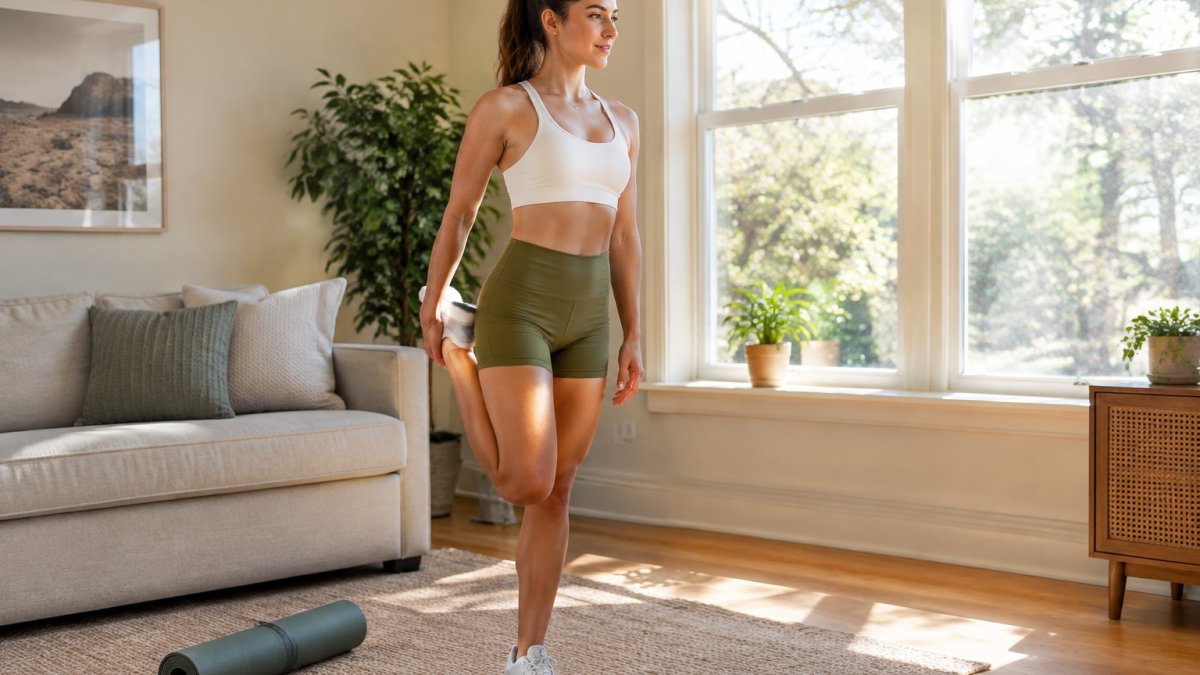
Cool down stretches after workout should be static and gentle. Static stretching means holding a position still, without movement, for 20 to 30 seconds. Save the dynamic work for your warm-up.
Lower Body Stretches
- Standing quad stretch: Hold your ankle behind you, knees together, 20 seconds each side.
- Standing calf stretch: Hands on a wall, one leg back, heel down, 20 seconds each side.
- Seated hamstring reach: Sit, extend one leg, hinge forward gently, 20 seconds each side.
Upper Body Stretches
- Doorway chest opener: Forearms on the frame, step through gently, 20 seconds.
- Cross-body shoulder stretch: Pull one arm across your chest, 20 seconds each side.
- Neck side stretch: Ear toward shoulder, no pulling, 15 seconds each side.
If you're new to this kind of movement, a full beginner guide helps. Our yoga for every body beginner guide walks through postures and breathing for cool downs.
Cool Down Exercises After Weight Training
Cool down exercises after weight training differ from a cardio cool down in one way: your muscles are already shortened and loaded.
Try these after a lifting session:
- Walk for two minutes to bring your heart rate down.
- Do five slow bodyweight squats, no weight, full range.
- Hold a deep lunge stretch for 20 seconds per side.
- Roll your shoulders back five times, slowly.
- Finish with four slow breaths.
Light resistance bands work well here for controlled mobility work. Our pink resistance bands set is a simple option for gentle leg and hip movement after lifting.
Watch out: don't chase a pump during your cool down. If you feel a burn, you've crossed from recovery into training.
Breathing and Mental Transition Rituals
Most cool-down guides stop at the physical. But the word "wind down" implies a mental shift too, and that's where a ritual earns its name. Breathing is the fastest physiological lever you have, and pairing it with a repeatable sensory cue is what turns a stretch session into a transition your brain recognizes.
Why the Exhale Does the Work
When you breathe in, your heart rate speeds up slightly. When you breathe out, it slows. A longer exhale than inhale therefore nudges you toward the parasympathetic nervous system, the rest-and-digest side, without you having to think about it. A 4-count inhale and 6-count exhale is a common starting point for a calming breath. If that feels rushed, try 4 in and 8 out.
Three Breathing Protocols (Pick One)
- Box breathing (4-4-4-4): Inhale 4, hold 4, exhale 4, hold 4. Good if you feel scattered and need structure. Repeat 4 rounds.
- Extended exhale (4-6 or 4-8): Inhale 4, exhale 6 to 8. The simplest option and the one most people default to after lifting.
- Physiological sigh: Two quick inhales through the nose, then a long slow exhale through the mouth. Repeat 3 to 5 times. Useful when your heart rate is still high and you feel keyed up.
Sit or stand tall for any of these. Don't force the hold if it feels strained, drop the hold and just extend the exhale.
Building a Sensory Anchor
The mental half of the ritual works through association. Pick one cue and repeat it every session so your brain starts linking it to "session over." Concrete options:
- Scent: A diffuser with the same calming oil each time. Lavender and citrus blends are common choices. Scent can serve as a memory cue, and repetition helps build the association.
- Sound: A two-minute playlist or a single track you only play during the wind down.
- Touch: A specific mat, a towel, or a textured roller you only use for recovery.
- Temperature: A warm shower after evening sessions, or a cool rinse after morning ones.
Pair the breathing with one small closing action, putting your mat away, wiping down equipment, changing your shirt. These cues tell your brain the session is closed.
A 3-Minute Mental Wind Down
- Minute 1: Extended-exhale breathing, 5 rounds.
- Minute 2: One sensory anchor, scent, sound, or a warm shower.
- Minute 3: One sentence of reflection. What felt good today? What will you adjust next session? Say it or write it, then stop.
Watch out: don't turn the reflection into a training log review. The point is to close the loop, not reopen it. If you find yourself planning the next workout, you've crossed from wind down into prep.
If you want to train your breathing properly, a lung training device with adjustable resistance gives your practice some structure. And if you'd rather learn from a book, Breathing Exercises For Dummies covers the basics in plain language.
Building a Post-Workout Recovery Routine That Fits Your Day
Your post-workout recovery routine has to survive real life. A plan that only works on quiet Sundays won't last. Build two versions: a five-minute one and a fifteen-minute one. Then adjust the shape of each based on when you train, because the same routine does different work at 7 a.m. and 9 p.m.
Morning vs. Evening Workouts
Morning sessions need a shorter wind down. You have a day to get to. Keep it to five minutes and lean on walking and breathing, the goal is to bring your heart rate down and shift into a focused, alert state, not to get sleepy.
Evening sessions deserve more time and a different tone. A longer stretch block, dimmer light, and a warm shower help you shift toward sleep. A calm, low-stimulation wind down in the evening can help you shift toward sleep. Practical adjustments for evening sessions:
- Lower the lights in the room where you cool down.
- Skip the intense playlist; use the same calm track each time.
- Take the warm shower after stretching rather than before.
- Keep the breathing protocol but extend the exhale, 4 in, 8 out, to lean further toward rest.
Shift workers face a different puzzle. If your "evening" is 6 a.m. after a night shift, treat it as evening: dim light, warm shower, extended exhale. Our guide to the best recovery tools for night shift workers covers fitting recovery around an unusual schedule.
Equipment-Free vs. Tool-Assisted Recovery
You can do the whole routine with nothing but floor space. That version is always available, which makes it the one to default to. The equipment-free version is: walk, breathe, four lower-body stretches, three upper-body stretches, one minute of stillness.
Tools add comfort and consistency, and they're worth it if they make the routine something you look forward to. A compression massager for feet and calves, a handheld massager, or a heating pad can each slot into the same five-minute template.
Time-Based Variations
- 2-minute version (travel or rushed days): 60 seconds walking, 4 extended-exhale breaths, 30 seconds of the single tightest stretch, 30 seconds of stillness.
- 5-minute version: The template above, walk, breathe, lower body, upper body, reset.
- 15-minute version: 3 minutes walking, 2 minutes breathing, 8 minutes of stretching with longer holds on your tightest areas, 2 minutes of stillness or a warm shower.
Watch out: don't stretch the routine by adding intensity. Extra time goes to walking, longer holds, and stillness, not to more load or more movement.
Time allocation in the 15-minute cool down version
Dos and Don'ts of Post-Workout Recovery
- Do cool down within 15 minutes of finishing.
- Do keep stretches static and gentle.
- Do breathe slowly with a longer exhale.
- Do repeat the same ritual each session.
Choosing Recovery Tools for Your Wind Down Routine
The right tool is the one you'll actually reach for.
For legs that feel heavy after standing or training, the LX1 foot and calf compression massager delivers compression from feet to calves, with optional heat or cold therapy.

For general muscle tension, the LX26 deep tissue massager comes with three interchangeable heads and 15-minute auto shut-off. It charges via USB for cordless use.

For neck and upper back tightness, the extra large microwave heating pad covers 28 by 22 inches with natural flax and rice filling.

To anchor the ritual with scent, our aromatherapy diffuser oils include lavender and calm blends for diffuser use.
Skip if: you want a tool for upper-body tension instead.
The hardest part of recovery isn't knowing what to do.
At Stronger Living Shop, we build recovery tools with intentional design and quality first.
Frequently Asked Questions
How long should a post workout wind down routine take?
Most people can complete an effective wind down in 5 to 10 minutes. A 5 minute cool down after workout works well on busy days: two minutes of walking, two minutes of static stretching, and one minute of deep breathing. If you have more time, extend the stretching portion to 10 minutes and add a warm shower or heat therapy. The key is consistency, not length.
What should a post-workout wind-down routine include?
A complete routine moves through three phases: a gradual transition with light aerobic activity like walking, static stretching for the muscle groups you trained, and a mental reset through deep breathing or a quiet moment. Adding a recovery tool such as a compression massager or heating pad can deepen the relaxation response, especially after heavy weight training or evening sessions.
Should you stretch after weight training?
Yes. Cool down exercises after weight training help reduce muscle tension and return your range of motion to baseline. Hold each static stretch for 20 to 30 seconds without bouncing. Focus on the muscles you loaded most, such as quads, glutes, hamstrings, chest, and shoulders. Stretching while your muscles are warm is safer and more effective than stretching cold.
Is a 5-minute cooldown enough after exercise?
For most moderate workouts, five minutes is enough to bring your heart rate down gradually and hit the major muscle groups. If you completed high-intensity intervals or heavy lifting, extend it to 10 minutes. Pair the physical cool down with a brief mental transition, like slow breathing, to signal to your parasympathetic nervous system that the session is over.
