

Table of Contents
- Why Do Yoga Pants Roll Down During Movement?
- Waistband Construction: High-Rise vs. Mid-Rise Explained
- How to Measure for Leggings: Getting Your Size Right
- How to Stop Leggings from Rolling Down: Practical Fixes
- Best Yoga Pants for No Rolling: What to Look For
- Moisture-Wicking Fabric and Why It Affects Fit Consistency
- Common Fit Issues and How to Troubleshoot Them
- Frequently Asked Questions
Last Updated: September 29, 2026
Why Do Yoga Pants Roll Down During Movement?
Yoga pants roll down because the waistband cannot hold its position against the forces of movement, gravity, and sweat. The fabric loses grip, the fit is wrong, or the construction was never designed for your body shape.
This guide breaks down the real causes and gives you fixes that work. Below, we cover why it happens, how to measure yourself properly, and what to look for in yoga pants that stay put.
Most guides blame "cheap fabric." That is only part of the story.
The Role of Fabric Elasticity and Compression
Elasticity is a fabric's ability to stretch and snap back to its original shape. When that snap-back fades, the waistband sags.
Most activewear uses elastane or spandex blended with nylon or polyester. Higher elastane content means better fabric recovery. Lower content means the waistband stretches out and stays stretched.
Compression matters too. A waistband that grips firmly creates friction against your skin. That friction is what holds the pants up. Too little compression and the fabric slides.
- High elastane (20%+): strong recovery, holds shape longer
- Low elastane (under 10%): stretches out fast, rolls down
- High compression: stays in place, but can feel tight
- Low compression: comfortable, but slides during movement
The Textile Exchange's materials overview explains how fiber blends affect stretch and durability.
Waistband Construction: High-Rise vs. Mid-Rise Explained
Waistband height changes where the pants sit on your body. That placement decides whether they stay up.
High-rise waistbands sit at or above your natural waist. This is the narrowest part of your torso, so there is less room to slide. Mid-rise sits below the navel, on a wider part of your body. That wider surface gives the band more room to slip.
| Waistband Type | Where It Sits | Roll-Down Risk | Best For |
|---|---|---|---|
| High-rise | Natural waist | Low | High-intensity, yoga, pilates |
| Mid-rise | Below navel | Medium | Low-impact, casual wear |
| Low-rise | Hips | High | Fashion, minimal movement |
High-rise wins for movement. The waist is a natural anchor point. Mid-rise can work if the band is wide and firm.
Seam Placement and Anatomical Fit Mechanics
Seam placement is the most overlooked cause of roll-down. A waistband seam that crosses your hip bones creates a pressure point. When you move, that seam catches and pushes the fabric down.
Good construction puts the main seam at your natural waist, away from bony landmarks. Flatlock seams reduce bulk and friction. A wide, contoured band follows your body's curves instead of fighting them.
This is anatomical fit mechanics: the band should mirror your body's shape, not sit as a straight tube.
How to Measure for Leggings: Getting Your Size Right
Knowing how to measure for leggings prevents most fit problems. You need two numbers: your waist and your hip.
Use a soft measuring tape. Keep it snug but not tight.
- Waist: Measure at your natural waist, the narrowest point above your navel.
- Hip: Measure around the fullest part of your hips and seat.
- Inseam: Measure from your crotch to where you want the hem to fall.
- Rise: Measure from your crotch up to where you want the waistband to sit.
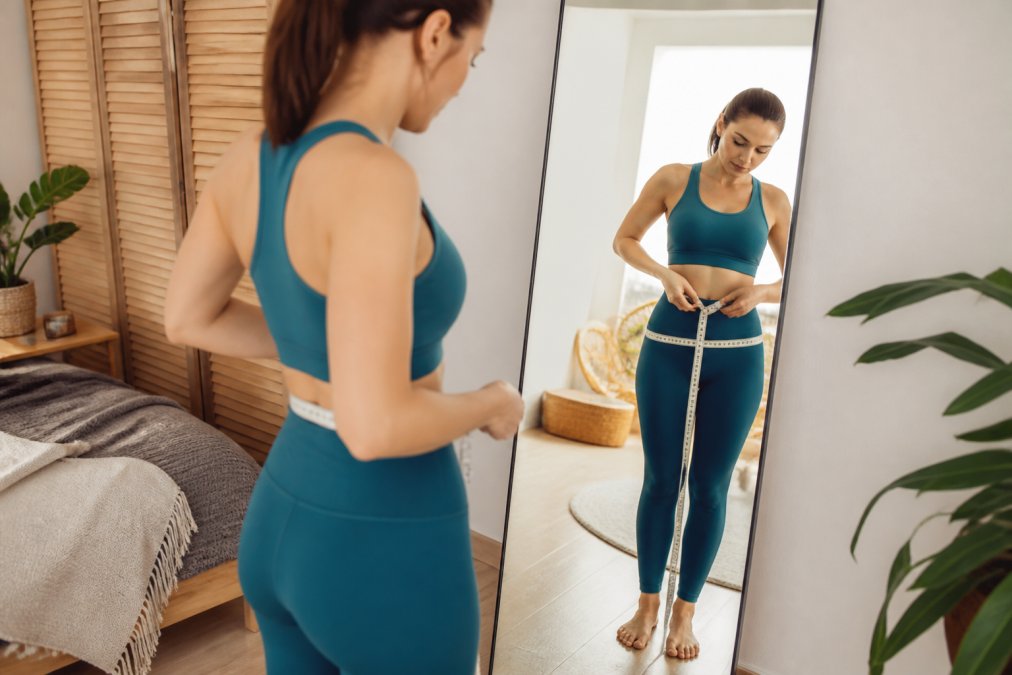
Your hip-to-waist ratio decides which size fits both areas. If your hips are much wider than your waist, you may need a curvy fit. Standard sizes assume a fixed ratio and often fail here.
How to Stop Leggings from Rolling Down: Practical Fixes
Learning how to stop leggings from rolling down starts with the right size. If the fit is correct, most roll-down stops.
Try these fixes in order:
- Size down if the band feels loose at your waist
- Size up if the band digs in and pushes down
- Choose high-rise for movement-heavy workouts
- Look for wide bands with strong elastane content
- Avoid cotton-heavy blends for high-intensity activity
DIY Temporary Fixes for Rolling Waistbands
Need a fix today? These work in a pinch.
- Fold the band down once to double the fabric thickness
- Tuck the band under a fitted tank or sports bra
- Use fashion tape along the inner band for grip
- Wear a fitted base layer to add friction
- Adjust the rise by pulling the band to your natural waist
These are short-term. For a lasting fix, the pants themselves need to fit.
Best Yoga Pants for No Rolling: What to Look For
The best yoga pants for no rolling share a few traits. Look for these before you buy.
- High elastane content for strong fabric recovery
- Wide, contoured waistband that follows your shape
- Flatlock seams placed at your natural waist
- Compression fabric that grips without digging
- Moisture-wicking material that stays light when wet
Our yoga wear is built with intentional design. We focus on quality first, so the fit holds through movement, not just the first wear.
Fit consistency matters more than any single feature. A pant that fits well on day one but sags by week four is not a good buy.
Moisture-Wicking Fabric and Why It Affects Fit Consistency
Sweat changes how fabric behaves. When a waistband soaks up moisture, it gets heavier and loses grip.
Moisture-wicking fabrics pull sweat away from your skin and spread it out to dry fast. This keeps the band light and maintains friction. Cotton holds water, gets heavy, and slides.
Fabric weight matters too. Lightweight fabrics dry fast but may lack structure. Heavier fabrics hold shape but trap heat. A mid-weight synthetic blend balances both.
Synthetic fibers like polyester and nylon outperform cotton for activewear. They keep their shape, shed water, and hold compression longer.
The FTC's guide to textile labeling explains what fiber claims on clothing labels actually mean.
Common Fit Issues and How to Troubleshoot Them
Most fit problems have simple causes. Here is how to diagnose and fix them.
| Problem | Likely Cause | Fix |
|---|---|---|
| Rolls down at waist | Band too loose or low-rise | Size down, switch to high-rise |
| Digs into skin | Band too tight or narrow | Size up, choose wider band |
| Slides during yoga | Low compression, cotton blend | Pick compression fabric |
| Sags after weeks | Poor fabric recovery | Choose higher elastane |
| Gap at back waist | Wrong hip-to-waist ratio | Try curvy fit or adjustable band |
Start with size. Then check the band width and fabric. Most roll-down issues trace back to one of these three.
Frequently Asked Questions
Are my leggings rolling down because they are too small?
Often, yes. When yoga pants are too tight, the fabric stretches beyond its natural recovery limit, causing the waistband to lose its grip and slide down. A too-small size also increases friction and pressure, which pushes the waistband downward during movement. Check the size chart and measure your waist and hips accurately. If the fabric feels overly stretched or leaves deep marks, sizing up usually solves the rolling problem.
How should high-waisted leggings fit to prevent rolling?
High-waisted leggings should sit comfortably at your natural waist, not above it or below it. The waistband needs to lie flat against your skin without digging in or gaping. There should be no excess fabric bunching at the top, and the band should stay in place when you bend or twist. If the waistband folds over or slides down immediately, the rise or size is wrong for your body type.
Does fabric quality affect why yoga pants roll down?
Yes. Lower-quality fabrics with poor elasticity or a low percentage of elastane or spandex lose their shape quickly and stop gripping the waist. Moisture-wicking synthetic blends with high elastane content and strong fabric recovery hold their fit through repeated wear and washing. Cotton blends without enough stretch tend to stretch out and roll down more easily, especially during high-intensity movement or hot yoga.
What are the best yoga pants that don't roll down?
Look for high-rise or mid-rise leggings with a wide, flat waistband and a high percentage of elastane or spandex for elasticity. Compression fabrics with moisture-wicking properties and durable seam construction keep the waistband in place during yoga, pilates, and high-intensity workouts. Prioritize fit consistency and fabric recovery over trendy designs. Always check the size chart and measure yourself before buying to ensure the best yoga pants for no rolling fit your body type.
Rolling waistbands are frustrating, but they are fixable. The cause is almost always fit, fabric, or construction, and all three can be corrected.
Stronger Living Shop designs yoga wear with intentional construction and quality-first materials. Our high-rise bands, strong fabric recovery, and moisture-wicking blends help you feel strong and stay focused through every pose. Explore our collection and find yoga pants that stay where you put them.