

Quick Summary
Mobility exercises for seniors with arthritis are gentle movements that take each joint through its comfortable range of motion. Do them slowly, seated if needed, stopping before sharp pain, once or twice a day.
- Hold each movement for 2-5 seconds and repeat it 5-10 times, once or twice a day.
- Start with the joints that feel stiffest, such as neck, shoulders, or hands.
- Increase repetitions to 8-10 in weeks three and four if joints feel good.
- Stop if you feel sharp pain, numbness, tingling, or a joint that gives way.
- Skip exercise and check with a doctor if a joint is hot, swollen, or painful at rest.
Table of Contents
- Why Mobility Exercises Help Seniors With Arthritis
- What You Need Before You Start
- Morning Stretches for Arthritis Stiffness
- Step-by-Step Range-of-Motion Exercises for Arthritis
- Building Up With Walking for Arthritis Joint Mobility
- Safe Exercise Tips for Seniors With Arthritis
- Pacing Your Week and Planning for Flare Days
- Starting Your Mobility Routine This Week
- Frequently Asked Questions
Why Mobility Exercises Help Seniors With Arthritis
Mobility exercises are gentle movements that take a joint through its normal range of motion.
Arthritis often makes joints feel tight, especially after rest (Osteoarthritis: Symptoms, Diagnosis, and Treatment). Moving them regularly helps the surrounding muscles and tissues stay flexible.
Here is what most seniors notice when they stick with a simple routine:
- Less stiffness when getting out of bed or a chair
- Better comfort when reaching, bending, or turning
- More confidence walking around the house
Mobility work does not replace medical care. If joint pain is sharp, sudden, or getting worse, talk with a doctor before starting any new program.
What You Need Before You Start
You do not need a gym or expensive gear to begin. A sturdy chair without wheels, a cushion for comfort, and a clear space to move are enough for most routines. Supportive, comfortable clothing also makes movement easier. Shoes with good grip help when you stand or walk.
If you want a structured guide, a seated program can be a good starting point. Consider a structured, illustrated seated guide for home practice to begin safely. The Chair Yoga Exercises for Seniors: The Guide for Strong and Flexible Body book is a guide to seated yoga practice at home.

Before you begin, keep these basics in mind:
- Choose a time of day when your joints feel most relaxed
- Keep water nearby
- Stop if you feel sharp pain or dizziness
Morning Stretches for Arthritis Stiffness
Morning stiffness is one of the hardest parts of arthritis, but a few gentle stretches can help. A seated Pilates and yoga program for loosening joints can also be done without standing balance demands.

Try these simple morning moves:
- Shoulder rolls: Roll your shoulders backward five times, then forward five times.
- Neck circles: Tilt your head gently side to side, holding each position for a few seconds.
- Ankle circles: Lift one foot slightly and rotate the ankle in both directions.
- Hand opening: Make a soft fist, then slowly spread your fingers wide.
Move gently and avoid bouncing. A little warmth from a warm shower or a heating pad before you stretch can also help joints feel looser.
Watch out: Do not force a stretch past the point of mild tension. Pushing through sharp pain can irritate the joint and make stiffness worse the next morning.
Step-by-Step Range-of-Motion Exercises for Arthritis
Range-of-motion (ROM) exercises move each joint through its full comfortable arc without forcing it. They are the foundation of an arthritis mobility routine because they help maintain flexibility, reduce morning stiffness, and keep daily tasks like dressing, reaching, and rising from a chair easier.
A simple rule many physical therapists use: move gently to the point of mild tension, hold for 2-5 seconds, and return slowly. Repeat each movement 5-10 times, once or twice a day. Start with the joints that feel stiffest.
A Complete Daily ROM Routine (10-15 Minutes)
Do these in order while seated in a sturdy chair without wheels, unless noted. Rest between movements as needed.
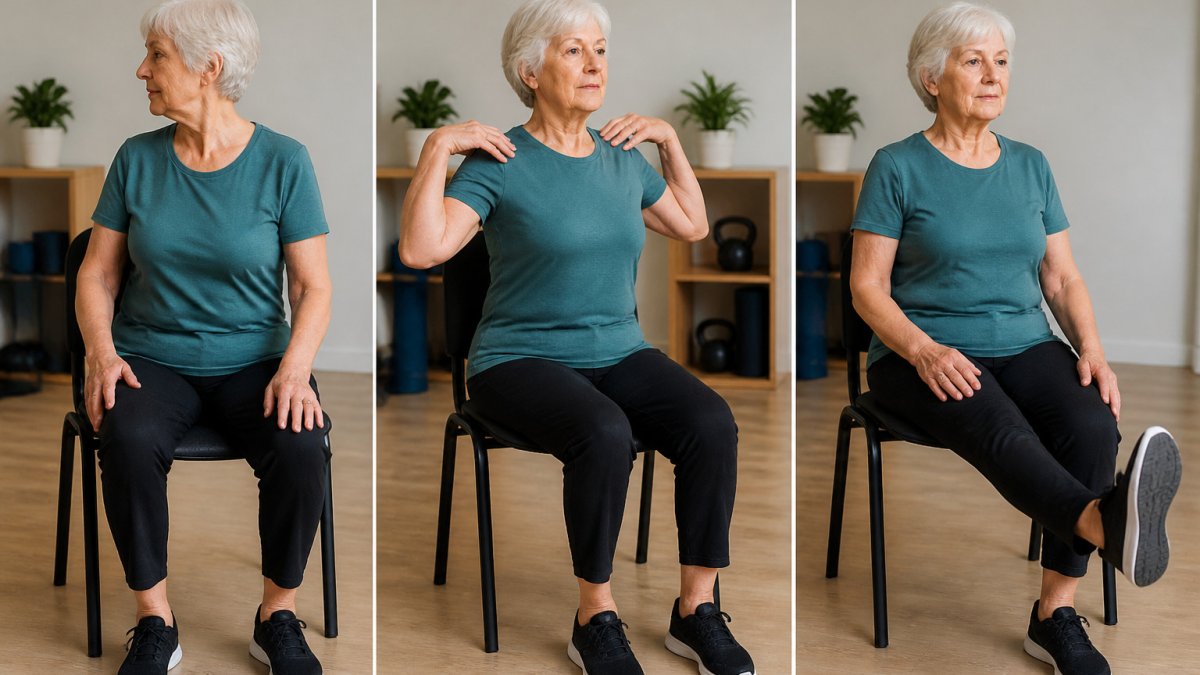
1. Neck turns and tilts (neck)
- Slowly turn your head to look over one shoulder, hold 2-3 seconds, return to center. Repeat 5 times each side.
- Tilt your head gently toward one shoulder, hold 2-3 seconds, return. Repeat 5 times each side.
- Avoid full circles if you have neck arthritis or dizziness.
2. Shoulder rolls and reaches (shoulders)
- Roll shoulders backward 5 times, then forward 5 times.
- Raise both arms forward to shoulder height, hold 2 seconds, lower. Repeat 5-8 times.
- Reach one arm across your chest, hold 5 seconds, switch sides. Repeat 3 times each arm.
3. Elbow bends and wrist turns (elbows, wrists)
- Bend one elbow to bring your hand toward your shoulder, hold 2 seconds, lower. Repeat 5-8 times each arm.
- Turn your palm up, then down, holding each position 2-3 seconds. Repeat 5 times each hand.
4. Hand and finger open-close (hands, fingers)
- Make a soft fist, then spread fingers wide. Hold open 2-3 seconds. Repeat 8-10 times.
- Touch your thumb to each fingertip in turn, then reverse. Repeat 2 rounds.
5. Seated leg extensions (knees)
- Straighten one leg in front of you until the knee is as straight as comfortable, hold 3-5 seconds, lower slowly. Repeat 8-10 times each leg.
- Do not lock the knee or swing the leg.
6. Seated marching and hip shifts (hips)
- Lift one foot a few inches off the floor, lower, then the other, like slow marching. Repeat 10 times each side.
- Shift your weight gently side to side to loosen the hips, 8-10 shifts.
7. Ankle circles and pumps (ankles)
- Lift one foot slightly and draw slow circles in each direction, 5 times each way. Switch feet.
- Point and flex each ankle 8-10 times.
Modifications by Affected Joint
Arthritis affects people differently depending on which joints are involved. Use these adaptations so the routine fits your body rather than fighting it.
Chair Yoga Exercises for Seniors: The Guide for Strong and Flexible Body →
- Hand and finger arthritis: Do the hand and wrist movements first while hands are warm (after a shower or with a warm towel). Use a soft foam ball instead of a towel for squeezing if gripping is painful. Skip tight fists; keep the fist soft.
- Shoulder arthritis: Keep arm raises below shoulder height if overhead motion is painful. Do tabletop slides or wall walks with fingertips instead of full reaches. Avoid behind-the-back reaches during a flare.
- Hip arthritis: Do hip shifts and seated marching before standing movements. If lying on your side is uncomfortable, do hip movements seated only. Use a cushion under the hip when sitting.
Progression: How to Build Up Safely
- Week 1-2: Do 5 repetitions of each movement once a day. Focus on smooth, slow motion.
- Week 3-4: Increase to 8-10 repetitions and add a second short session if joints feel good.
- Week 5+: Add gentle resistance only if pain is stable, for example, a light resistance band for shoulder and elbow movements. Never add resistance during a flare.
Arthritis Foundation exercise guidance
The routine below summarises each movement, the joint it targets, and how many repetitions to do, as the article describes.
| Step | Joint | Repetitions |
|---|---|---|
| Neck turns and tilts | Neck | 5 each side |
| Shoulder rolls and reaches | Shoulders | 5-8 reps |
| Elbow bends and wrist turns | Elbows, wrists | 5-8 reps |
| Hand and finger open-close | Hands, fingers | 8-10 reps |
| Seated leg extensions | Knees | 8-10 each leg |
| Seated marching and hip shifts | Hips | 10 each side |
| Ankle circles and pumps | Ankles | 5 each way |
Building Up With Walking for Arthritis Joint Mobility
Walking is a low-impact activity that supports joint movement and overall endurance. Browse durable everyday workout wear built for regular, repeated activity. Many seniors find it easier to start short and build up slowly. Begin with two or three minutes around the house, rest, then repeat.
A simple way to build up is to add a little time each week:
- Week 1: Walk for 5 minutes, twice a day
- Week 2: Walk for 7 minutes, twice a day
- Week 3: Walk for 10 minutes, once or twice a day
Choose flat, even surfaces and wear supportive shoes. If a walk causes swelling or lasting pain, rest and scale back.
Safe Exercise Tips for Seniors With Arthritis
Safety comes first with any mobility routine. A few habits can make exercise more comfortable and reduce the risk of injury.
- Warm up gently before stretching
- Move slowly, never bounce or jerk
- Use a sturdy chair or wall for balance
Comfortable clothing matters too. See guidance on workout clothes that won't restrict or irritate during movement.
Watch out: Skipping rest days can lead to more soreness. Give your joints a day off each week or switch to lighter movement when you feel tired.
Pacing Your Week and Planning for Flare Days
Arthritis symptoms rise and fall, and a plan that ignores flares usually fails. Pacing means spreading movement across the week and adjusting on bad days instead of pushing through or giving up. Short, frequent sessions are often easier on arthritic joints than one long workout.
A Sample Weekly Plan
This is a template, not a prescription. Adjust the days and durations to how your joints feel.
- Monday: Morning stretches (5-10 min) + full ROM routine (10-15 min)
- Tuesday: Gentle walking (10-20 min, split into two short walks if needed)
- Wednesday: Morning stretches + ROM routine
A common pattern is a mix of stronger days, lighter days, and at least one rest day. If a session leaves you more sore the next day, that is a signal to shorten it rather than add to it.
How to Pace During a Good Stretch
When joints feel good, it is tempting to do more. Use these rules to avoid the boom-and-bust cycle:
- Increase walking time gradually, a few minutes at a time.
- Add only one new movement at a time, and give it a week before adding another.
- Keep at least one rest day each week, even on good weeks.
Flare-Day Plan: What to Do When Symptoms Spike
A flare is not a failure, it is a signal to change the plan, not abandon it. A practical flare-day approach:
- Scale down, don’t stop completely unless advised. Do 2-3 gentle ROM movements for the affected joint, or switch to a different joint. For example, if knees are flaring, do neck, shoulder, and hand movements.
- Use warmth or cold. A warm shower, heating pad, or warm towel before movement can ease stiffness; cold packs can help a hot, swollen joint. Follow your clinician’s advice on which to use.
- Protect the joint during daily tasks. Use larger joints when possible, slide objects instead of lifting, and use jar openers or grip aids for hands.
- Prioritize rest and sleep. Fatigue often accompanies flares; short rest periods during the day are part of treatment, not laziness.
- Stay hydrated and keep meals simple. There is no single arthritis diet, but steady hydration and regular meals support recovery.
- Check in with your clinician if a flare lasts more than a few days, involves a hot swollen joint, or comes with fever, those can signal something more than a routine flare.
Returning to Activity After a Flare
Ease back in rather than resuming at the previous level:
- Day 1-2 after symptoms settle: Gentle ROM only, half the usual repetitions.
- Day 3-4: Add short walks or seated movement if joints remain calm.
- Day 5+: Return to the normal weekly plan if soreness does not increase.
If soreness returns with each increase, stay at the lower level for another week. Progress is not linear, and a slower return often prevents the next flare.
CDC physical activity guidance for arthritis
Starting Your Mobility Routine This Week
You do not need to do everything at once. Pick two or three movements from this guide, set a time each day, and start there. Small, steady sessions add up over weeks.
Track how your joints feel and adjust as you go. If you have questions about your condition or want personalized advice, speak with your doctor or a physical therapist.
Frequently Asked Questions
What are the best mobility exercises for seniors with arthritis?
The most useful mobility exercises for seniors with arthritis are gentle range-of-motion movements: ankle circles, seated knee extensions, shoulder rolls, neck circles and hand stretches such as a slow towel squeeze. Perform each movement slowly within a comfortable range, hold for a few seconds where it feels right, and repeat 5 to 10 times. Choose movements that target the joints that feel stiff, and build the routine gradually rather than all at once.
Should seniors with arthritis exercise when joints are stiff or painful?
Light movement usually helps stiff joints more than rest does, so gentle mobility work is generally appropriate on stiff days. Start with a short warm-up such as a few minutes of seated movement or a warm shower, then keep the range small. Sharp pain, new swelling, or pain that lasts for hours afterward is a sign to stop, reduce the range or intensity, and check with a doctor or physiotherapist before continuing.
When should someone with arthritis stop exercising?
Stop an exercise if you feel sharp or stabbing joint pain, notice new or increasing swelling, feel unusual warmth or redness in a joint, or experience dizziness, chest discomfort or shortness of breath. Pain that is still noticeable more than about two hours after exercise, or that makes you sleep worse, suggests you did too much. Reduce the range or repetitions next time, and speak to your healthcare provider if symptoms do not settle.
How long should seniors with arthritis exercise each day?
Many seniors with arthritis do well with 10 to 20 minutes of gentle mobility work most days, split into shorter sessions if needed. Walking or other aerobic activity can be added in periods of around 10 minutes and built up over several weeks. Consistency matters more than length, so a short routine repeated daily is more useful than a long session done once a week.
