

Table of Contents
- Why a Gaiam Alternative for Yoga Gear Is Worth Considering
- Quick Comparison: Gaiam Alternative Yoga Gear at a Glance
- Gaiam vs. Manduka Yoga Mat and Gaiam vs. Jade Yoga: How the Big Names Compare
- The Best Yoga Mat Material for Grip on Hardwood, Carpet, and Hot Classes
- The Best Travel Yoga Mat for Portability and Home Practice
- Cushioning, Thickness, and Joint Support: 3mm vs. 5mm vs. 1/2-Inch
- Durability, Material Safety, and Long-Term Ownership Costs
- Frequently Asked Questions
Last Updated: October 21, 2026
Why a Gaiam Alternative for Yoga Gear Is Worth Considering
If you have been loyal to the same big-box yoga brand for years, you are not alone.
A gaiam alternative for yoga gear is any mat, block, strap, or bag from a brand that competes on material quality, grip, and durability rather than name recognition.
The short answer most guides miss: the brand matters far less than the material under your hands.
Quick Comparison: Gaiam Alternative Yoga Gear at a Glance
Here is how our top picks line up. Each is chosen for a specific job, so scan the "best for" column before comparing prices.
| Product | Price | Material / Thickness | Best For |
|---|---|---|---|
| Hot Yoga Mat (Natural Rubber) | $118.25 | Natural rubber, PU surface, 5mm | Hot and sweaty classes, grip |
| Retrospec Solana Mat | $39.70 | TPE, 1/2 inch, 72 × 24 in | Joint cushioning, floor work |
| Foldable Travel Mat | $38.13 | PVC, 3mm, 72 × 32 in | Travel, home practice, storage |
| 7-Piece Yoga Set | $67.98 | Mat + blocks, strap, towels, knee pad | Beginners building a full kit |
| Yoga Blocks 2-Pack | $20.84 | EVA foam, 9 × 6 × 3 in | Balance, stretching, handstands |
| 10-Loop Stretch Strap | $9.84 | Polyester webbing, 76 in | Flexibility, physical therapy |
Now let's look at how these choices stack up against the names you already know.

Gaiam vs. Manduka Yoga Mat and Gaiam vs. Jade Yoga: How the Big Names Compare
The comparison comes down to construction philosophy. Gaiam mats are built for accessibility: lightweight, affordable, and widely available in foam and PVC.
Gaiam vs. Manduka Yoga Mat
A Gaiam vs. Manduka yoga mat comparison centers on density and price. Manduka's signature mats are heavier and firmer, which many practitioners prefer for standing poses where stability matters more than softness. Gaiam's foam mats are lighter but compress faster. If you practice five or more times a week, the firmer construction is worth the extra weight.
Gaiam vs. Jade Yoga
The Gaiam vs. Jade Yoga question is really about grip material. Jade Yoga builds its mats from natural rubber, which grips better as it warms up.
Our natural rubber hot yoga mat follows the same logic: a PU surface over a dense rubber base, 5mm thick, with a strap included for carrying. It is the closest thing to a dedicated hot-class mat in our lineup.
The Best Yoga Mat Material for Grip on Hardwood, Carpet, and Hot Classes
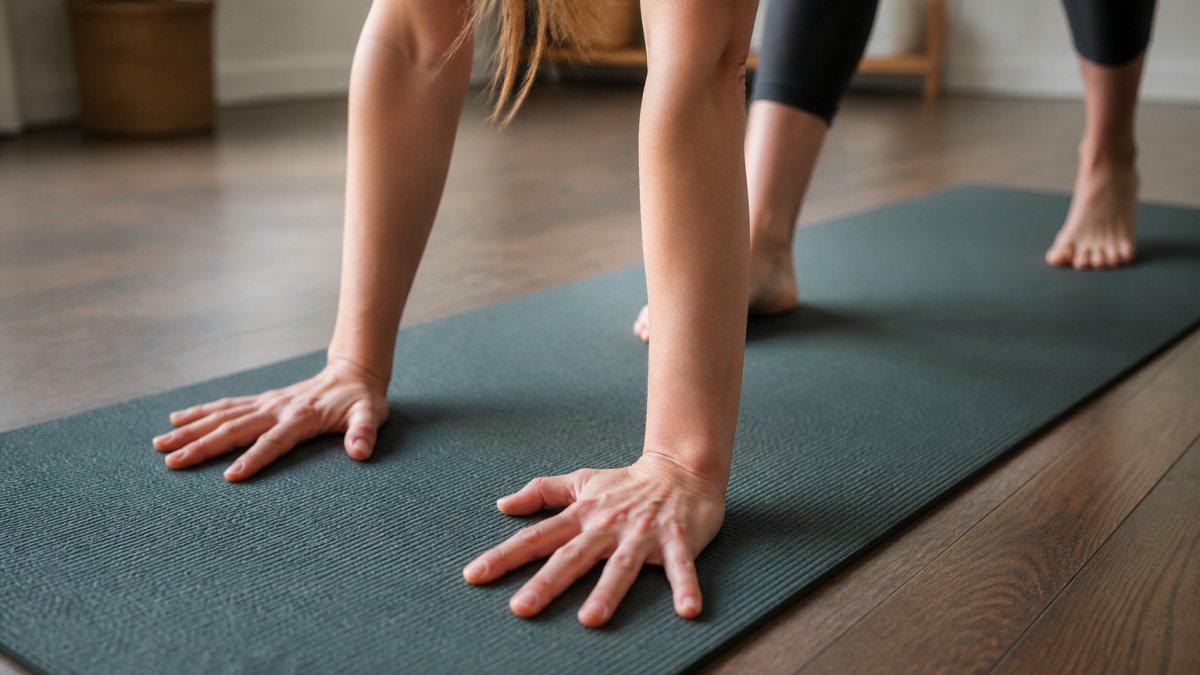
The best yoga mat material for grip depends on the surface beneath it and how much you sweat. Natural rubber and textured PU grip best on hardwood. PVC holds steady on carpet because its firm structure resists sinking.
Why grip changes from surface to surface
Grip is friction, which depends on how much surface area your hands and feet contact and whether the mat conforms to the floor without sliding. On smooth hardwood, a dense mat with a tacky top layer creates the most contact and resists lateral shear. On carpet, a soft mat sinks into the pile and shifts during lunges, which is why firm PVC often feels more stable there than softer rubber.
How each material behaves in practice
- Natural rubber: Best traction on hardwood and in hot rooms because the rubber base grips smooth floors and the closed-cell surface stays tacky as it warms. Heavier than foam, and it needs airing out when new. In hot classes, a PU top layer over rubber is common because PU absorbs moisture rather than letting it pool.
- PVC: Firm and stable on carpet because its dense structure resists sinking into pile. Less eco-friendly and can be slippery when damp, so it is a poor match for hot rooms.
- TPE: Lightweight and latex-free; good all-round grip on hardwood and carpet but softens over time, so grip fades with heavy use.
Surface-by-surface guidance
| Surface | Best material | Why it works | Watch out for |
|---|---|---|---|
| Hardwood | Natural rubber or PU-topped rubber | Rubber base grips smooth floors; PU handles sweat | Heavier to carry; air out new rubber |
| Carpet | PVC or dense TPE | Firm structure resists sinking into pile | Less eco-friendly (PVC); can slip when damp |
| Hot studio | Natural rubber with PU top, or cork | Moisture is absorbed rather than pooling | Needs cleaning after every class |
| Travel or multi-surface | TPE or foldable PVC | Light and consistent across floors | Grip fades with heavy use |
A common mistake is buying a foam mat for a hot studio. It will slide under your hands by the second flow. Match the material to the room, not the price tag.
How to test grip before you commit
You do not need a lab to compare mats. A simple at-home check tells you most of what you need:
- The palm press: Place both palms flat and press forward as if entering plank. A mat that wrinkles or slides is too soft or too smooth for your floor.
- The sweat test: Mist a small corner with water and repeat the palm press. Natural rubber and PU stay tacky; foam and some PVC become slick.
- The barefoot twist: Stand in a lunge and rotate the back foot. A stable mat stays put; a poor one bunches under the arch.
- The edge check: Lift one corner. If the mat curls and stays curled, it will not lie flat on hardwood without weight.
If you practice mostly at home on hardwood, a 5mm natural rubber mat covers daily practice and hot classes. On carpet, a firmer PVC or dense TPE mat feels more planted. If you split time between studio and travel, keep a foldable 3mm mat for the road rather than asking one mat to do both jobs.
The Best Travel Yoga Mat for Portability and Home Practice
The best travel yoga mat is one you will actually carry: light, packable, and stable enough to practice on without sliding. Our foldable mat weighs roughly 3.75 lb, folds to 15.7 × 12 × 1.3 inches, and comes with a storage bag, so it fits in a carry-on or under a desk.

Foldable beats rollable for travel in one key way: it lays flat instantly. Rolled mats need time to relax, and a curled corner ruins a forward fold. At 3mm thick and 72 × 32 inches, it gives you extra width without the bulk.
Hot Yoga Mat Non Slip-Professional Grade Natural Rubber Yoga Mat, Pliates Mat →
For home practice, pair it with a carrying strap or a tote. The JupiterGear canvas tote fits most standard and thick mats.
Cushioning, Thickness, and Joint Support: 3mm vs. 5mm vs. 1/2-Inch
Thickness is about joint support, not comfort alone. A 3mm mat keeps you close to the floor for balance poses. A 5mm mat adds cushioning without losing stability.
| Thickness | Cushioning | Stability | Best For |
|---|---|---|---|
| 3mm | Low | High | Travel, balance, experienced practitioners |
| 5mm | Medium | High | Daily practice, hot classes, all-round use |
| 1/2 inch | High | Medium | Joint support, Pilates, floor work, beginners |
If your knees complain in kneeling poses, the Retrospec Solana at 1/2 inch is the practical pick, and it is BPA-free TPE. If you want one mat for everything, 5mm natural rubber is the sweet spot.

Durability, Material Safety, and Long-Term Ownership Costs
A mat that costs more upfront often costs less over five years. Foam mats compress and shed within a year of daily use; natural rubber and dense TPE hold their shape far longer. Here is how to think about durability, safety, and total cost of ownership across a full gear setup.
What actually wears out, and when
Different parts of a mat fail on different timelines. Knowing which failure you are likely to hit tells you where to spend.
- Top surface (grip layer): The first thing to go on any mat. Foam and some PVC surfaces glaze over and lose tack within months of daily practice; natural rubber and PU hold grip longer but still degrade if cleaned with harsh solvents.
- Core density: Foam compresses permanently under knees and hands, creating thin spots that no longer cushion. Dense rubber and TPE resist compression far longer.
- Edges and seams: Curling edges are usually a storage problem, not a material failure. Rolling a mat loosely and storing it flat preserves the edges.
A budget foam mat typically lasts about a year of daily practice before grip and cushioning decline, while a dense rubber mat can last several years with basic care.
Care routines that extend life
- After every hot class: Wipe the top surface with a damp cloth and mild soap, then air-dry fully before rolling. Never roll a damp mat.
- Weekly: A deeper clean with diluted mild soap keeps PU and rubber surfaces tacky. Avoid alcohol-based cleaners, which strip grip layers.
- Storage: Roll loosely, store flat or upright in a dry space, and keep natural rubber out of hot cars and damp closets.
Material safety: what to look for and what the labels mean
Material safety matters as much as durability, especially for practitioners who spend an hour a day with skin on the mat.
- Latex-free TPE: A good choice for anyone with a latex sensitivity. The Retrospec Solana is latex-free and made without phthalates or heavy metals, and it wipes clean with mild soap and water.
- BPA-free construction: A common claim on TPE and some PVC mats. It is a useful starting point, not a complete safety guarantee.
- Phthalates and heavy metals: Look for explicit statements that these are not used. If a listing is silent, ask the brand directly.
The full-kit ownership view
Ownership cost does not stop at the mat. A complete setup includes blocks, a strap, a towel, and a bag, each with its own wear pattern:
- EVA foam blocks: Light and affordable, but they dent and crumble at the corners with heavy use. They are the first accessory to replace.
- Cork or wooden blocks: Heavier and firmer, and they hold up far longer than foam, which makes them the lower-cost choice over several years.
- Straps: Polyester webbing is the durable standard; the weak point is usually the buckle or loop stitching, so check those first.
Build a complete kit around whichever mat you choose: two EVA foam blocks, a 10-loop strap, and a towel for hot classes. Buying accessories once, from a brand that stands behind them, is the cheapest path over time. Spend on the items that touch the floor and your hands every session, and replace cheap consumables only when they fail.
Frequently Asked Questions
What are the best alternatives to Gaiam yoga mats?
Stronger Living Shop offers several strong Gaiam alternative mats. The Hot Yoga Mat (118.25) uses natural rubber with a PU surface for grip in sweaty classes. The Retrospec Solana (39.70) is a 1/2-inch TPE mat for joint cushioning. The Foldable Travel Mat (38.13) is a 3mm PVC option that folds into a bag. Each targets a different practice style, so pick based on grip needs, cushioning, and portability.
Which yoga mat material offers the best grip?
Natural rubber with a PU top layer offers the best grip for hot and sweaty practice, which is why the Hot Yoga Mat uses it. TPE provides reliable traction for general home practice and is latex-free. PVC gives a firm, stable surface with double-sided texture for dynamic flows. For hot classes, rubber and PU win. For dry home practice, TPE and PVC are sufficient and cost less.
Is a 3mm or 5mm yoga mat better?
A 3mm mat like the Foldable Travel Mat is lighter and packs flat, making it the best travel yoga mat for carrying to class. A 5mm mat like the Hot Yoga Mat adds cushioning for knees and wrists during longer sessions. If you have joint sensitivity, a 1/2-inch TPE mat offers even more padding. Choose 3mm for portability, 5mm for a balance, and thicker for joint support.
What should I look for in a travel yoga mat?
Look for low weight, a fold or roll that fits a bag, and enough grip for the surfaces you practice on. The Foldable Travel Mat weighs about 3.75 lb, folds to 15.7 x 12 x 1.3 inches, and includes a storage bag. The JupiterGear Tote Bag (24.99) fits most mat sizes if you prefer to carry a rolled mat. Prioritize portability and grip over thickness for travel.
Are thicker yoga mats better for beginners?
Thicker mats help beginners who feel pressure on knees and wrists, but too much thickness can reduce stability in standing poses. A 1/2-inch mat like the Retrospec Solana (39.70) cushions well for floor work, while a 5mm natural rubber mat keeps you grounded for balance. Beginners should match thickness to their practice: more padding for restorative and floor work, less for standing balance.
The real challenge is not finding a mat. It is finding gear that matches how you actually practice, then holding up to it. Stronger Living Shop curates premium wellness and fitness essentials with intentional design and quality first, from natural rubber hot yoga mats to complete 7-piece sets and supportive accessories. Explore the collection and build a setup that helps you feel strong and thrive every day.